

OT threat detection means watching the network that runs your physical process, from pumps and breakers to conveyors and signals, and recognizing when something on it is wrong. For operators with small teams, the practical answer is passive monitoring: a sensor listens to a copy of your network traffic, builds an inventory of what is there, and flags behavior that does not belong, with no agents, no active probes and no changes to production. That is how we built Tabor Security's passive OT network monitoring.
TL;DR
- OT threat detection starts with knowing every asset and what normal traffic looks like. Alerts without that baseline are mostly noise.
- Passive monitoring on a mirrored (SPAN) port gives visibility without touching controllers, which matters when safety and uptime come first.
- The signals to watch are new connections between IT and OT, unexpected commands and function codes, configuration changes, new devices and unusual remote logons.
- Federal guidance from CISA, NIST and NERC all point to inventory plus continuous monitoring.
- Tabor's sensor is preconfigured for rapid deployment and gives plain-language alerts and compliance reports for teams without a large security staff.
Table of Contents
- What OT threat detection is, and why it differs from IT
- What attacks look like in industrial networks
- The signals worth watching
- Protocol behavior is where the evidence is
- Step by step: building detection with a small team
- Why detection is harder in OT
- What U.S. rules ask of operators
- Where Tabor fits
- FAQ
- Sources
What OT threat detection is, and why it differs from IT
Operational technology, as NIST defines it, is programmable systems that interact with the physical environment: industrial control systems, building automation, transportation systems and physical access control. Detecting threats there means spotting malicious or abnormal activity in those systems and the networks that connect them.
The priorities differ from IT. According to NIST SP 800-82 Rev. 3, IT security ranks confidentiality, integrity and availability, while OT ranks safety first, then availability, integrity and confidentiality. That changes how detection must work:
- You cannot scan a PLC the way you scan a laptop. An active probe can stall a device that has run for fifteen years.
- You cannot reboot a system to install an agent.
- A false alarm that prompts someone to shut down a process has a physical cost.
The same NIST guide says alert thresholds should come from baselines of normal network traffic and process behavior, which is the reason inventory and baselining come before any alerting.
What attacks look like in industrial networks
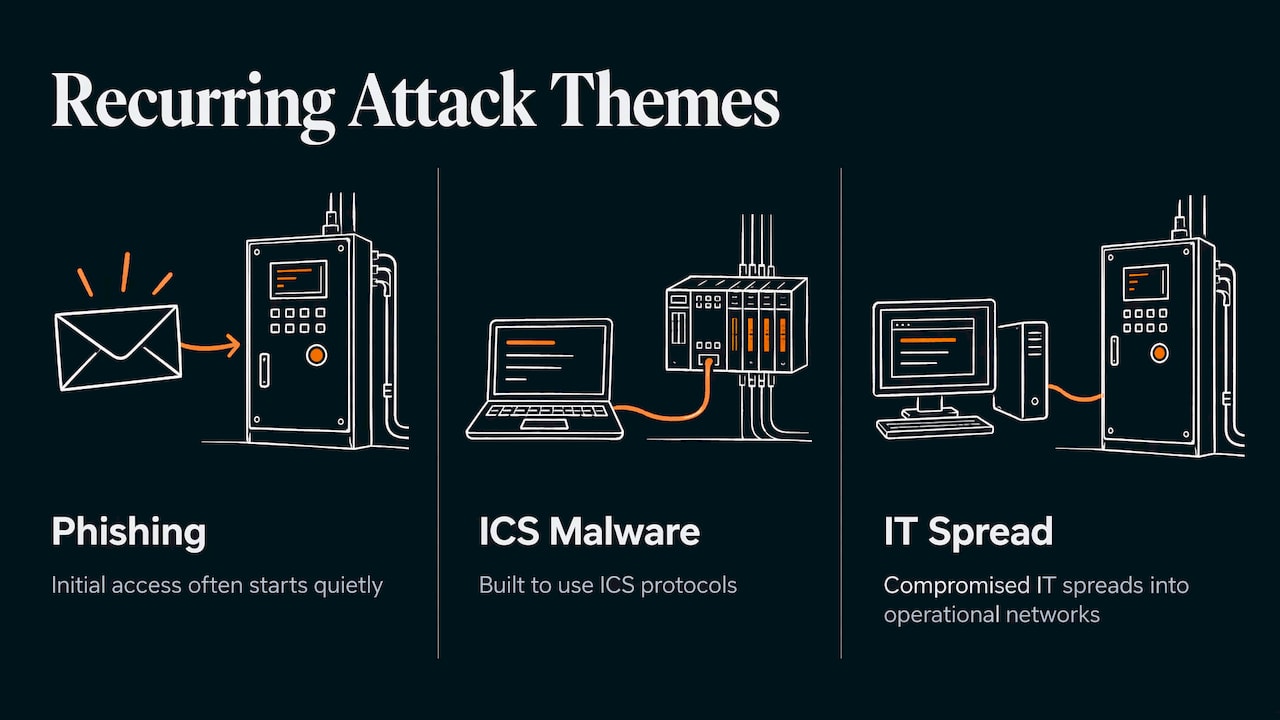
Operators often picture a dramatic event. Real intrusions usually start quietly, and CISA's Best Practices for Industrial Control Systems names the recurring themes: phishing for initial access, malware built to use ICS protocols, and compromise of the IT network followed by spread into operational networks.
The joint NSA/CISA advisory AA22-265A describes what advanced actors do once inside. They can manipulate HMIs (the screens operators use), alter control points such as breaker operations, block reporting communications and deny operators control. Physical consequences range from overfilled tanks to equipment destruction. The advisory also cites TRITON, which modified in-memory firmware on safety controllers to disable safety systems.
That sequence is useful for detection. Each step leaves a trace on the network: a new connection from IT, a device talking to something it never has, a command nobody scheduled.
The signals worth watching
CISA's ICS monitoring considerations tell operators to look for:
- Indicators of known malicious activity
- Suspicious connections between OT and external networks, including enterprise IT and the internet
- Unauthorized connections between OT segments, including non-IP links
- Configuration changes to OT assets
- New or unauthorized applications
- Unnecessary exposed ports, protocols and services
NIST SP 800-82 Rev. 3 adds OT-specific events: communications on new ports or protocols, unusually heavy traffic, unauthorized devices joining the network, traffic to external IP addresses and unexpected remote logons. It also notes that shared credentials make anomalous behavior harder to attribute to anyone.
For electric operators, the NERC reliability guideline lists human-visible signs: loss of multiple SCADA components at once, unexplained breaker operations, suspicious telemetry, anti-malware alerts on operator HMIs and unauthorized USB sticks or wireless access points in a control center. It advises reporting unusual behavior even though some will prove harmless.
Protocol behavior is where the evidence is
Industrial protocols carry meaning. A Modbus write, a DNP3 control command or an OPC UA session says what a device is being told to do. Idaho National Laboratory's threat hunt guide walks through the common ones: Modbus/TCP on port 502 has no authentication or encryption, DNP3 on port 20000 is legacy plaintext and spoofable, IEC 61850/MMS on port 102 is often poorly segmented, and MQTT can become an exfiltration path.
The guide's indicators of attack, written for battery storage but applicable to any control network, include:
- East-west traffic between devices with no reason to talk
- Repetitive outbound connections that look like beaconing
- Protocols running on non-standard ports
- Write or operate commands aimed at setpoints
- Rare function codes outside maintenance windows
- Timing that breaks the expected master-slave cycle
An academic review of 40 SCADA/ICS intrusion detection studies found protocol-aware features in only two of ten recent studies, and called this protocol blindness a critical gap: the function codes and command types are what separate a legitimate operation from an attack. Detection that only counts packets misses it.
Step by step: building detection with a small team
1. Inventory what you have
You cannot detect an unauthorized device if you do not know the authorized ones. CISA's August 2025 asset inventory guidance tells owners and operators to build an inventory and taxonomy, then cross-reference assets against CISA's Known Exploited Vulnerabilities catalog and the CVE database.
Where it goes wrong: spreadsheets built from memory and purchase records. They miss the laptop a vendor plugged in and the radio nobody documented. Tabor's sensor inventories and classifies industrial assets from observed traffic and maps the network topology, so the list comes from what is actually talking.
2. Listen passively
Idaho National Laboratory recommends passive monitoring to baseline device behavior without disrupting operations. The usual method is a SPAN port, a switch setting that sends a copy of traffic to a monitoring port. Nothing sits inline and nothing can break the process if the sensor fails.
Where it goes wrong: tools that actively query devices, or need agents on equipment that cannot host them. Tabor's approach uses a preconfigured SPAN-port sensor with no agents, active probes, inline devices or changes to production networks.
3. Establish a baseline
The same INL guide suggests at least 30 days of data to capture normal variation, including shift patterns and maintenance windows. Skipping this is the main cause of alert fatigue: a monthly batch job looks like an attack if the system has only seen two weeks.
4. Detect events and explain them
With a baseline, new devices, new conversations, unexpected function codes and configuration changes stand out. The harder part is meaning. An alert that says "anomaly score 0.87" gives a plant operator nothing to act on. A Vanderbilt survey of OT network security notes operators are unwilling to trust black-box alerts that could interrupt a physical process. Tabor's alerts are written in plain language, so an operator without a security background can see what happened and where.
5. Map to frameworks and respond carefully
CISA's guidance suggests mapping observed behavior to the MITRE ATT&CK matrix for ICS. NERC's point on response is to lean on operators' knowledge of their own systems and report oddities rather than assume they are benign. Treat each alert as a question for the people who run the process before anyone changes anything.
Why detection is harder in OT
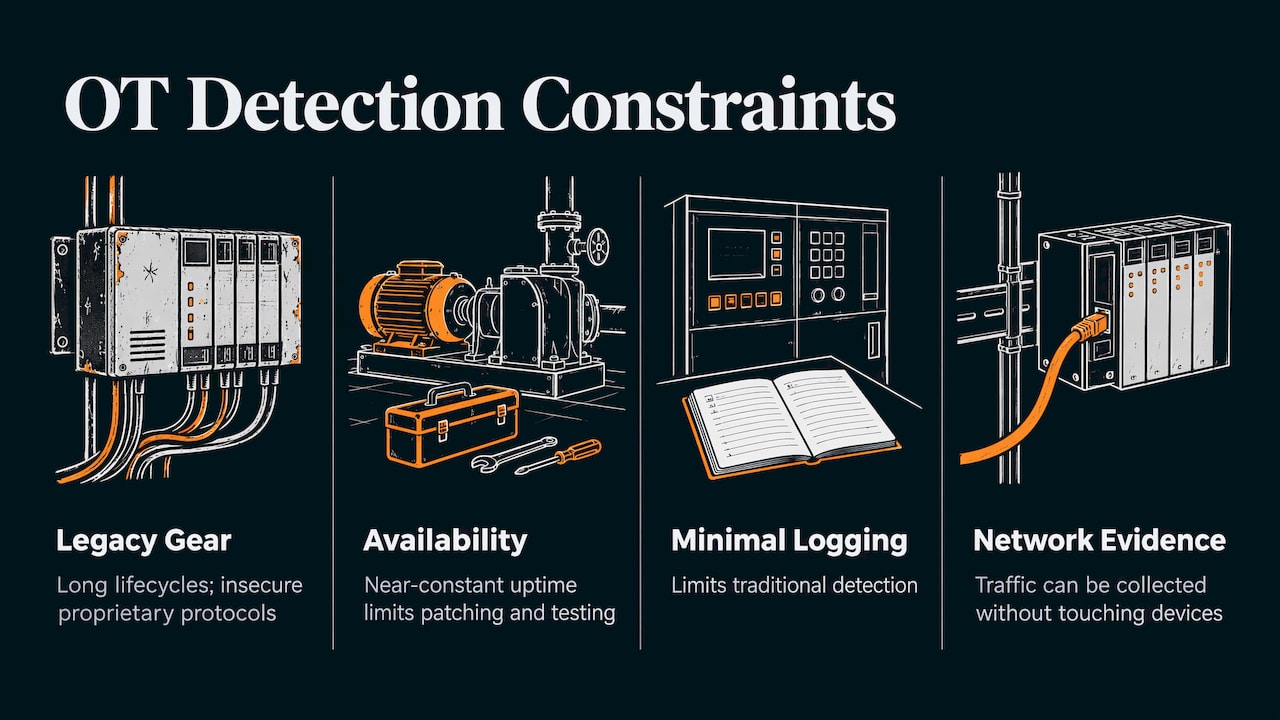
CISA's April 2026 zero trust guide for OT explains the constraints: legacy devices have long lifecycles and insecure proprietary protocols, near-constant availability limits patching and testing, and minimal logging limits traditional detection. The same guide warns against relying on air-gapping or segmentation alone, since modern threats can exploit a false sense of isolation.
That is the case for watching the network itself. When devices cannot log or be patched, traffic is the one source of evidence you can collect without touching them.
False positives matter too. In controlled evaluations, the Frontiers review reports rates of 0.8% to 2.1%, and the Vanderbilt survey notes tuning remains a practical challenge when legitimate process changes are frequent. A good baseline and context-rich alerts are what keep that manageable.
What U.S. rules ask of operators
What applies depends on your sector:
- Electric: FERC's September 2025 notice proposed approving NERC CIP-003-11, which adds detection of malicious communications to or between low-impact BES Cyber Systems with external routable connectivity.
- Pipelines, rail and bus: TSA's November 2024 proposed rule would extend cyber risk management requirements to pipeline, freight rail, passenger rail and bus operators and require incident reporting to CISA within 24 hours.
- Everyone buying OT technology: CISA's Secure by Demand guidance gives buyers priority considerations when evaluating vendors.
Check the official pages for the current status of any proposal. Tabor's compliance page covers its reporting mapped to security frameworks, and its OT security briefing covers threats and regulations.
Where Tabor fits
Tabor Security serves mid-market utilities, transportation operators and manufacturers that need OT visibility without a large budget or a dedicated security team. The product is a subscription: a preconfigured sensor on a SPAN port plus a cloud platform that inventories and classifies assets, maps topology, monitors traffic, detects events, explains alerts in plain language and generates compliance reports mapped to security frameworks. The sensor is designed for rapid deployment, and customers can book a walkthrough or evaluation before subscribing.

If your plant has a mirrored port and no way to see what crosses it, start at Tabor Security.
FAQ
Can you detect OT threats without disrupting operations?
Yes. Passive monitoring listens to a mirrored copy of traffic, so nothing is injected into the process and nothing sits inline. Idaho National Laboratory recommends this approach for baselining device behavior without disrupting operations.
What should an OT threat detection tool alert on first?
Start with new devices, new connections between IT and OT, configuration changes and unexpected commands or function codes. These match the events listed in CISA and NIST guidance and are the clearest signs that something has changed.
How long does it take to learn what normal looks like?
INL suggests at least 30 days of data to capture normal variation. Longer helps if your process has seasonal or maintenance cycles.
Is an asset inventory really part of threat detection?
Yes. CISA's asset inventory guidance pairs inventory with real-time monitoring, because an unknown device is only visible as unknown when the known ones are listed.
Sources
- NIST SP 800-82 Rev. 4 initial public draft
- NIST SP 800-82 Rev. 3, Guide to OT Security
- CISA, Cybersecurity Best Practices for Industrial Control Systems
- NSA/CISA advisory AA22-265A
- CISA, ICS monitoring technology considerations
- NERC reliability guideline for system operators
- Idaho National Laboratory, Threat Hunt Guide for BESS Environments
- Frontiers in Computer Science, explainable hybrid intrusion detection review
- CISA, Foundations for OT Cybersecurity: Asset Inventory Guidance
- CISA, Adapting Zero Trust Principles to Operational Technology
- arXiv, Cyber security of OT networks: a tutorial and survey
- FERC notice on NERC CIP-003-11
- Federal Register, TSA proposed rule 89 FR 88488