
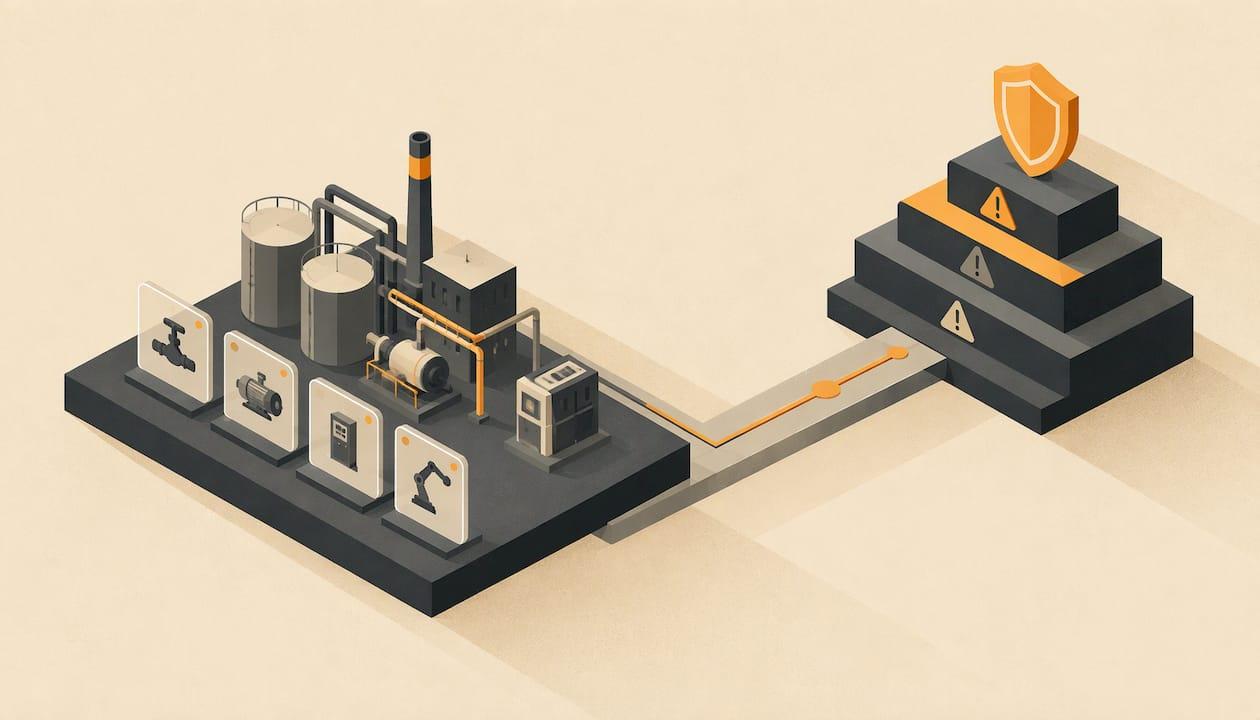
OT vulnerability management is the routine of knowing which devices run your plant, finding the known weaknesses in them, deciding which ones matter for your process, and fixing or fencing them off without stopping production. It starts with an accurate asset inventory, and the safest way to build one is by listening to network traffic instead of probing devices. That is the approach behind Tabor Security's passive OT monitoring: a SPAN-port sensor that inventories and classifies your industrial assets without agents, active probes, inline devices or changes to your production network.
This guide walks through the routine step by step for utilities, manufacturers and transportation operators who have a small team, a tight budget and equipment that cannot be rebooted on a whim.
TL;DR
- You cannot manage vulnerabilities in devices you have not identified. An asset inventory (vendor, model, firmware, software versions) comes first, per CISA's asset inventory guidance.
- Passive monitoring finds assets and exposure without touching fragile controllers. Active scanning needs a risk decision, a test environment and usually a planned outage.
- Rank findings by exploitation status, reachability and what the asset does in your process, not by CVSS score alone.
- When a patch has to wait, a documented compensating control (isolation, added monitoring, replacement planning) is a legitimate outcome.
- Record every decision. Auditors and incident responders both ask for the trail.
Table of Contents
- What OT vulnerability management covers
- Why OT is not IT with different hardware
- Step 1: Build the asset inventory
- Step 2: Identify vulnerabilities without disturbing the process
- Step 3: Prioritize by risk to your process
- Step 4: Patch, or mitigate and document
- Step 5: Measure and document
- What the latest federal guidance means for you
- Start with visibility
- FAQ
- Sources
What OT vulnerability management covers
CISA describes operational technology as the systems that control critical infrastructure, including programmable logic controllers (PLCs), human-machine interfaces (HMIs), SCADA and distributed control systems. So SCADA and OT are not the same thing: SCADA is one kind of OT system, the supervisory layer that collects data from field devices and lets operators command them. OT is the whole family, and "ICS" (industrial control systems) is the term often used for the same family. Vulnerability management for any of them follows the same logic.
The Operational Technology Cyber Security Alliance defines the work as monitoring public sources for vulnerabilities, evaluating your exposure, and carrying out mitigations. Its core activities are:
- Create and maintain an OT asset inventory.
- Source vulnerability disclosures, such as the NIST National Vulnerability Database, ICS-CERT advisories, MITRE and vendor bulletins.
- Map each disclosed vulnerability (a CVE) to the assets it affects, using product identifiers.
- Analyze risk and prioritize remediation.
Everything below is that cycle, adapted to a plant floor.
Why OT is not IT with different hardware
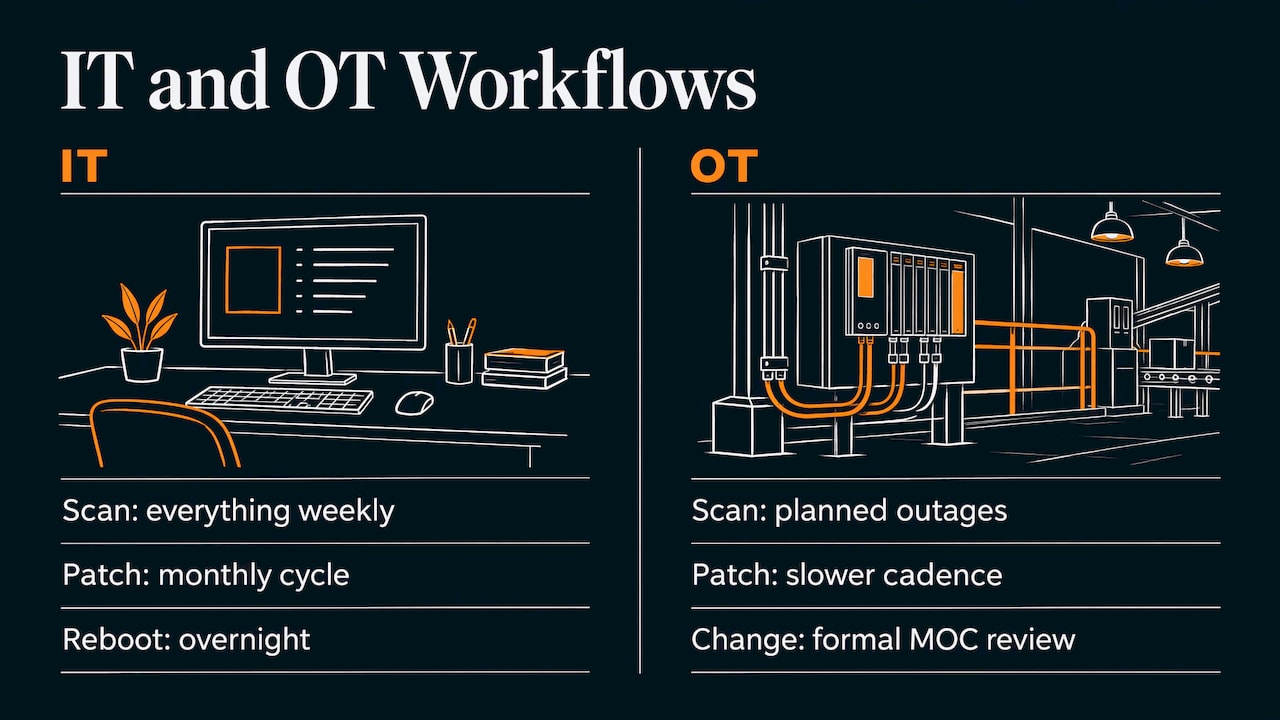
In an office network you scan everything weekly, patch on a monthly cycle and reboot overnight. On a plant floor, three things change.
Availability and safety come first. A controller that restarts at the wrong moment can stop a process or create a safety event. CISA's zero trust guidance for OT says changes must follow a formal Management of Change process with engineering, safety and operational reviews, and that OT change cadence is almost always slower than IT patch cadence.
Devices are fragile and long-lived. Many controllers cannot take an agent, and some react badly to unexpected traffic. NIST's guide to OT security tells owners to make a risk-based decision about active scanning, passive monitoring or compensating controls, to test scanning tools offline before production, and to schedule scans in planned outages whenever possible.
A patch may not exist, or may not be installable. Vendors must validate patches for their equipment, and the line may be out of support. That is why mitigation is as much a part of the program as patching.
The result: OT vulnerability management is slower, more document-heavy and more dependent on engineers than its IT cousin. A scanner-and-ticket workflow copied from the office will not survive contact with production.
Step 1: Build the asset inventory
CISA's August 2025 guidance calls the asset inventory foundational and directs owners to pair it with an OT taxonomy, then cross-reference the inventory with the Known Exploited Vulnerabilities (KEV) Catalog and the CVE database. NIST asks for the same detail per asset: vendor, model, firmware, operating system and software versions.
Where it goes wrong: spreadsheets built from purchase records and walk-downs go stale within months. Engineering laptops, vendor-installed gear and devices added during an outage never make it in. Without an accurate list, every later step rests on guesses.
What we do here: our sensor connects to a SPAN port, which is a switch port that mirrors traffic for monitoring. From that copy of the traffic it inventories and classifies industrial assets and maps the network topology. Nothing is installed on a controller and nothing is placed in the data path, so there is no change to the production network to schedule or approve. Our product page shows what the inventory and topology views contain.
Step 2: Identify vulnerabilities without disturbing the process
With an inventory in hand, you match what you have against what is known. The sources are the ones the OTCSA lists, plus the KEV Catalog, vendor advisories and your sector's information-sharing group. The Idaho National Laboratory's Equipment Assessment Guide tells owners to research vendor bulletins, the CVE database, ICS-CERT advisories and sector ISACs. A NERC security guideline adds two habits: ask suppliers for a software bill of materials (SBOM), a list of the components inside a product, so you can tell whether a newly announced component flaw affects you, and set up both push notifications from vendors and periodic pull checks.
How you collect version data matters as much as where you match it. A sensible order for a cautious team:
- Engineering documents and vendor tools.
- Passive observation of network traffic.
- Active scanning only where the owner and the vendor agree it is safe, normally in a maintenance window.
That sequence follows the assessment steps described by OTVista and NIST's treatment of vulnerability scanning in OT. Passive monitoring is also what many OT teams actually use: in SANS's ICS/OT survey, 47% of teams rely on passive network monitoring to discover control system vulnerabilities.
Where it goes wrong: teams run an IT scanner against a subnet "just to see" and learn the hard way what a fragile device does with unexpected packets. Keep production off the test bench: NIST suggests testing in representative labs or on replicated systems instead.
What we do here: because the sensor only observes, you get continuous visibility into what is on the network, how it communicates, and which events deserve attention, with alerts explained in plain language rather than protocol jargon. That matters for operators who do not have a dedicated OT security analyst.
Step 3: Prioritize by risk to your process
A list of 400 CVEs is not a plan. Three inputs turn it into one.
Is it being exploited? CISA advises using the KEV Catalog as the authoritative input to a prioritization framework such as SSVC (Stakeholder-Specific Vulnerability Categorization), and mapping attack patterns to MITRE ATT&CK for ICS. A vulnerability with known exploitation in the wild jumps the queue.
Can an attacker reach it? The OTCSA notes that CVSS gives a severity score but no asset-specific context, and recommends combining severity with asset criticality and the number of affected assets. CISA's zero trust guide warns against assuming security from air-gapping or segmentation alone, and says risks should be ranked by likelihood and potential impact, with high-risk assets getting stricter access control and closer monitoring.
What does the asset do? A flaw in a historian server and the same flaw in a controller that runs a chlorination pump are not equal. Rate each asset Critical, High, Medium or Low against your process.
SANS adds that CVSS alone is insufficient and that priority should favor actively exploited flaws, remote code execution, abuse of native ICS protocols and remote-access compromise.
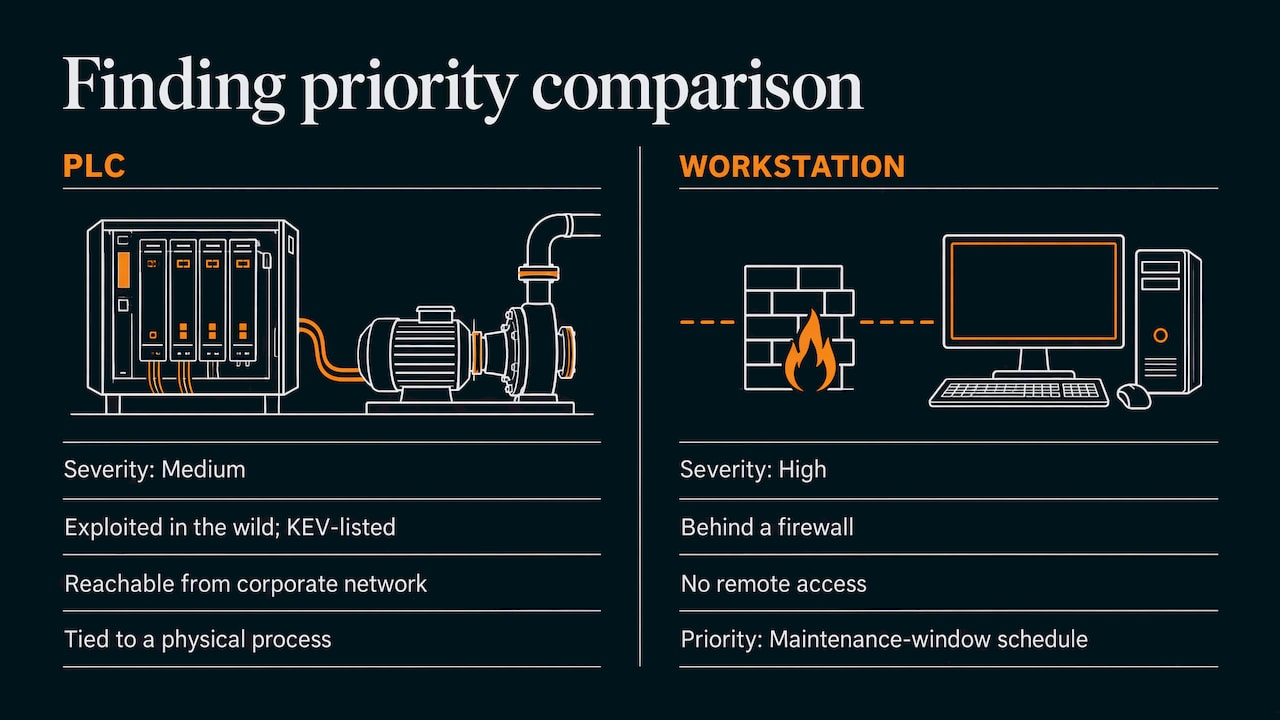
A worked example. A water utility has two findings: a high-severity flaw on an engineering workstation that sits behind a firewall with no remote access, and a medium-severity flaw on a PLC reachable from the corporate network that appears in the KEV Catalog. The PLC goes first: it is exploited in the wild, reachable and tied to a physical process. The workstation goes on the maintenance-window schedule.
Where topology matters, our sensor's network map shows which devices actually talk to which, so reachability is something you can read off the map instead of infer.
Step 4: Patch, or mitigate and document
The INL guide lays out the safe sequence: test patches in a lab or on a similar device, verify the patch's authenticity using the vendor's hash or signature, apply it in a maintenance window, and when patching is not possible, use compensating controls such as isolation, added monitoring or replacement, and document the decision.
CISA's asset inventory guidance says to schedule mitigations during maintenance windows unless urgency forces an emergency change, and to compare the cost of downtime with the cost of replacing a legacy system or adding compensating controls. SANS describes mature ICS programs as having moved beyond "patch everything" campaigns: they weigh downtime, production disruption and patch failure risk against adversary potential, and work closely with engineering. In the SANS survey, 34% of teams apply vendor-validated patches on a pre-tested, engineering-defined schedule.
A practical decision table:
| Situation | Typical response |
|---|---|
| Patch available, tested, maintenance window coming | Apply in the window, record firmware level before and after |
| Patch available but untested on your configuration | Test on a lab or spare device first, then schedule |
| No patch, device reachable from other zones | Isolate or restrict access, add monitoring on that device's traffic |
| Device out of vendor support | Compensating controls now, replacement in the capital plan |
| Known exploited, internet-exposed | Treat as emergency change through your Management of Change process |
Monitoring is the control that keeps an unpatched device honest. Once a vulnerable asset is fenced off, you still want to see unusual traffic to and from it. Our sensor monitors traffic and detects events, so the compensating control you document has an observable signal behind it.
Step 5: Measure and document
An OT program that cannot show its work fails audits and slows incident response. Track at least:
- Percentage of assets with a known firmware and software version.
- Number of open findings by priority, and their age.
- Mitigation plans past their target date.
- Network changes or new devices that appeared without a change record.
If you operate bulk electric system assets, NERC CIP sets the cadence. The INL guide notes that NERC CIP requires a documented patch management process for BES Cyber Systems, with patch review every 35 days for high and medium impact assets, and audit-trail records of firmware and patch levels. Other sectors have their own frameworks, and an inventory kept current is the common denominator.
Our compliance reporting generates reports mapped to security frameworks from the data the sensor already collects, which takes the evidence-gathering off a small team.
What the latest federal guidance means for you
Two recent changes are worth knowing. NIST's draft SP 800-82 Rev. 4 widens OT scope to include building automation, water and wastewater, food and agriculture, freight rail and maritime and reorganizes around the NIST Cybersecurity Framework 2.0. And CISA's Binding Operational Directive 26-04, issued June 10, 2026, sets risk-based patching timelines based on exposure, KEV status, exploit automation and technical impact.
A binding directive applies to federal agencies, not private operators. But it shows where expectations are heading: timelines that depend on exposure and exploitation, not on a flat score. CISA's own summary of the directive is that defenders should patch smarter, not harder. The same page notes that BOD 26-02 encourages replacing end-of-support devices, which supports the replacement-planning row in the table above.
For a current view of threats and regulations affecting operators, see our OT security briefing.
Start with visibility
Every step above depends on knowing what is on your network. Tabor Security is built for mid-market critical infrastructure: utilities, transportation and manufacturing operators without large budgets or security teams. Our preconfigured sensor is designed for rapid deployment, connects to a SPAN port, and works without agents, active probes, inline devices or changes to production. You get an asset inventory, a network map, traffic monitoring, event detection with plain-language alerts, and compliance reports mapped to security frameworks, delivered as a subscription through the sensor and cloud platform.

If you want to see it on your own network, you can book a walkthrough or evaluation from the Tabor Security site.
FAQ
Are SCADA and OT the same thing?
No. SCADA is one type of OT system: the supervisory layer that gathers data from field devices and lets operators control them. OT also includes PLCs, HMIs and distributed control systems, per CISA. A vulnerability program should cover all of them.
Can I run a normal vulnerability scanner on OT?
NIST tells owners to decide between active scanning, passive monitoring and compensating controls based on risk, to test scanning tools offline first, and to schedule any active scans for planned outages. Passive monitoring avoids the question for day-to-day discovery because it only observes traffic.
How often should OT vulnerabilities be reviewed?
It depends on your framework. For high and medium impact bulk electric system assets, NERC CIP calls for patch review every 35 days. Outside NERC, set a regular review cycle, and handle known exploited vulnerabilities as they appear through an escalation policy, as CISA recommends.
What should I do when a device cannot be patched?
Use a compensating control and document it: isolate the device, restrict who can reach it, add monitoring on its traffic, and plan replacement. The INL guide treats a documented decision as part of the process, not a failure.
Sources
- Guidance for Asset Owners and Operators, CISA
- Vulnerability Management for Operational Technology, OTCSA
- Adapting Zero Trust Principles to Operational Technology, CISA
- NIST SP 800-82r4 initial public draft
- Foundations for OT Cybersecurity: Asset Inventory Guidance, CISA
- Equipment Assessment Guide, Idaho National Laboratory
- Security Guideline: Product Security Sourcing Guide, NERC
- Risk-Based Vulnerability Management and Patching Industrial Systems, SANS
- SP 800-82 Rev. 4, NIST CSRC
- BOD 26-04: Prioritizing Security Updates Based on Risk, CISA
- Secure Critical Infrastructure, CISA